Influencers alike gathered at Google Fiber on Thursday, Dec.8 for DivInc’s inaugural Demo Day.
The event showcased ten diverse technology entrepreneurs who participated in the organization’s 12-week pre-accelerator program, where they were given access to investors, workshops and technical experts.
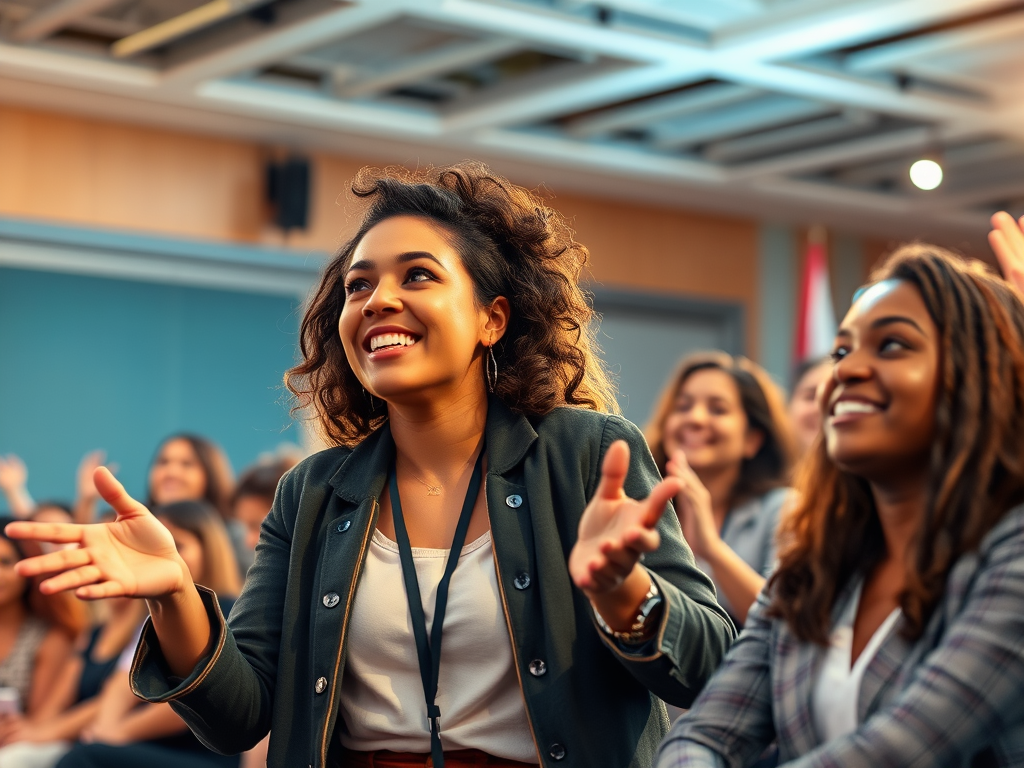
Mentors enthusiastically introduced techpreneurs to the stage as they pitched their company to a packed audience.
On stage, Redenim founder Kelly Ernst described her company’s vision as straightforward, saying, “We want you to get in our pants.” Redenim is a marketplace for designer jeans for affordable lease through a membership program.
Ernst told the Austin Urban Post that the growth she experienced while at DivInc was tremendous compared to last year.
“If you are not focusing on what you are doing, your company is going to flounder,” said Ernst. “My company would not be what it is [today] if were not for DivInc… and their leadership team’s ability to help bring focus to what we are doing.”
Plume founder, Bobby Menefee
Bobby Menefee, founder and CEO of Plume — a millennial solution to building credit through a mobile app — held the same sentiments as Ernst toward DivInc, which was formed to address the lack of diversity in the tech startup ecosystem.
“The 12-week program, it was a significant opportunity for me. It really [allowed] me to get my foot in the door,” said Menefee. “I learned so much… I feel like I [am hopefully carrying] this momentum going forward.”
At the event, DivInc also announced that they are currently accepting applications for their next group of technology entrepreneurs.
Co-founder Preston James expressed his enthusiasm for the completion of the organization’s inaugural program.
“It’s an amazing feeling. It’s very gratifying and I am extremely proud of the founders for the progress they’ve made,” he said.
To view all those who participated in the program, visit divinc.org.
Planned Parenthood can be added to a long list of groups that the Trump administration has verbally condemned and threatened for expressing their First Amendment rights.
Since one of their services goes against his pro-life beliefs, President Trump handed the women’s health care organization a hefty ultimatum, saying that Planned Parenthood will continue to see government funding only if the abortions stop.
Trump wishes to block Planned Parenthood from federal assistance in order to prevent abortion, but the Hyde Amendment of 1976 already took care of that. The law allows government funds to go toward abortion only in the cases of rape, incest or when the mother’s life is in danger.
After it was passed, the amendment was challenged in the Supreme Court where it was upheld that “The funding restrictions of the Hyde Amendment do not impinge on the ‘liberty’ protected by the Due Process Clause of the Fifth Amendment held in Roe v. Wade…to include the freedom of a woman to decide whether to terminate a pregnancy…”
The government aid Planned Parenthood receives goes not toward funding abortions but instead toward funding critical health care services — such as pap smears, birth control, family planning and HIV testing — for 2.5 million Americans annually.
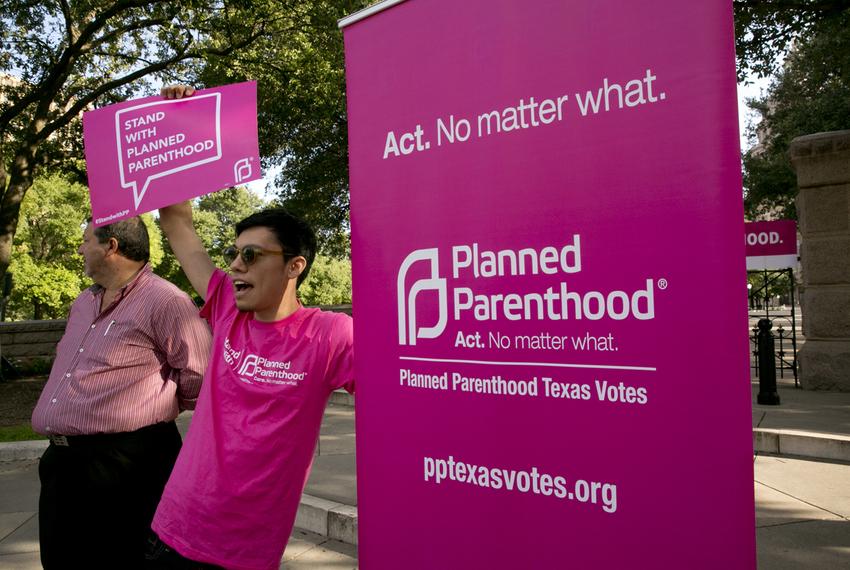
Men and women alike march in support of Planned Parenthood. via. Getty Images.
The $500 million cut that Trump has cautioned would injure countless lives of both women and men alike. Certainly, Planned Parenthood serves men, too — the very people Trump swore to protect when he took office. For men, the nonprofit provides vasectomies, condoms and cancer screenings, among other gender-appropriate services.
Whether it’s through information sharing, surgery or examinations, Planned Parenthood’s supply of sexual and reproductive procedures and education saves lives. And it is the low-income patients, men and women, who rely on Planned Parenthood because often they cannot afford their own health care insurance, that would suffer the most were federal dollars to be discontinued.
If Trump follows through on his threats, that will only increase the rates by which Americans are at risk of unwanted pregnancies, sexually transmitted diseases and several types of cancer.
In the documentary “Cartel Land,” director Matthew Heineman portrays an unexpected side to the drug war.
His story goes a little something like this.
In early 2013, Dr. José Manuel Mireles Valverde of Michoacán took up arms with other town residents to form the Autodefensas. The group of vigilantes fought in the name of self-protection — to repel the Los Caballeros Templarios cartel from their community.
As they found ascendancy, the paramilitary faction aimed toward something bigger: to eliminate the cartel band from each city in Mexico.
The movement gained force. Cue federal dismantle.
Mexican officials gave them a choice: disband or join us as part of the Rural Defense Force. And hey, we’ll load you up with guns and vests if you choose the latter.
Most gave in. Some, like Dr. Mireles, refused.
Before long, the same men who joined the Autodefensas with wholesome intentions were out in a deserted field under a night sky tending to a big black pot of steaming meth. As the film ends, one of the cooks acknowledges — “We’re the lucky ones. For now.”
Cartel Land poster. Via: (Collider Movie Talk)
Writing for the New Yorker, Dan Slater reflects on Heineman’s film: “The drug war is typically depicted as a problem of hypocrisy and delusion in the United States, and of tumult in Mexico. It’s a matter of ‘corruption,’ one hears. But corruption… fails to convey the extent of the problem… there is no accountable government; no public trust exists that can be broken… in a void of central authority, evil moves through the poor communities of a narco state with a cancerous gravity, making every cell sick.”
Innocent people turned casualties of a war they wanted no part of.
Those who join the cartel typically do so for one of two reasons. The first, that it’s one of few means by which a person can escape poverty in rural Mexico.
Given the nature of their work, it’s hard to conceptualize that these drug producers might possess motives similar to our own — they are capitalists, seizing on a market.
The second, that joining the cartel is often the only way to escape the cartel. The gang has infiltrated our southern neighbor across all tiers of society: government, police, military and civilians alike.
Since 2007, some 236,000 homicides have been reported in the bureaucratic black hole. An estimated 27,000 are missing. Half live in poverty. Violence and torture related to organized crime run rampant.
Those who dare to rebel against the system do so nobly, but will likely end up either as another bad guy or as a subject of the bad guys’ manhunt, as was the fate of Dr. Mireles, who now sits in a Michoacán prison awaiting trial. As he once said, you can’t stop the cartel, no matter what you do.
Who are the real criminals of the drug war? Before pointing your finger toward Mexico, ask yourself: would you, given the chance, take revenge on the man who killed your mother, father, sister, brother, husband or wife? Would you join a cartel if not joining meant dying? If they were coming to your house, would you have the courage to rumble?
War by its nature is cyclical. Patterns of retaliation combined with deep-rooted institutional corruption make it hard to envision Mexico ever freeing itself from cartel-induced mayhem.
U.S. policy is largely responsible for the demand the cartel supplies. Indeed, as America’s war on drugs took full effect, we began to see the rise of cartels. Most trace their origin to the Guadalajara cartel, formed in 1980 by Miguel Ángel Félix Gallardo.
Escalation of the drug war has only proven to make these drugs more valuable.
Sanho Tree, director of the Drug Policy Project at the Institute for Policy Studies, broke this thought down for The Huffington Post’s Marc Lamont Hill: “Things like cocaine, heroine, marijuana — these are minimally-processed agricultural commodities,” he said. “They’re very easy to produce… They’re very cheap to produce. There’s no reason they should be worth this kind of money that people are willing to kill, and torture and massacre over.”
For the cartel, the riskier a transport, the more it’s going to cost — production fees that must be remade in sales and distribution, one might suppose.
To work toward eliminating illegal drug trade, drug decriminalization, like what’s beginning to happen with marijuana, is a good start.
Sufficient, widespread decriminalization would mean far less people in prison, unfortunate news for those who make billions annually off the incarcerated population — like the $70 billion private prison industry, or the Department of Justice’s Asset Forfeiture Fund, which collected $4.5 billion from state seizures of cash and property in 2014, according to their own report.
Ending the war on drugs would certainly lose such entities money, but it’s action well worth the cost if it helps to bring about peace in Mexico and on the border.
Mexico needs reform, as does the U.S. For them, it’s economic, political, social and institutional resuscitation. For us, it’s changes in policy that embrace drug treatment instead of punishment, impartiality instead of discrimination, empathy instead of callousness.
Overdose took 50,000 American lives in 2014.
Common forces drive people to abuse drugs. A study by the Kaiser Southern California Permanente Medical Group, for example, found that those who endure four or more traumatic childhood events (including but not limited to sexual abuse, violence against mother and living with a substance abuser) are 4 to 12 times more likely to experience alcoholism, drug abuse and depression than those who endured none.
Our government’s systematic response to drug use and abuse contains no compassion for such human tendencies. Instead, it serves to capitalize on our fallibilities, ultimately forgoing public well-being for the sake of profit and power.
It’s no secret the war on drugs has failed. But there’s more to it than that. The drug war is actively harming an American public it’s supposed to be protecting.
The first anti-drug legislation in the United States – passed by San Francisco in 1875 – was rooted in anti-immigrant sentiment: it banned opium smoking, a habit unique to the Chinese.
Comparably, former Richard Nixon administrators have openly confessed racism was one of the reasons for the president’s declaring a war on drugs in 1971.
“We knew we couldn’t make it illegal to be either against the war or black, but by getting the public to associate the hippies with marijuana and blacks with heroin, and then criminalizing both heavily, we could disrupt those communities,” Nixon’s domestic policy chief John Ehrlichman told Harper’s magazine.
Nixon launched a war on drugs despite knowing that drug treatment works and incarceration doesn’t, according to Dan Baum in his book “Smoke and Mirrors.”
Before long, prison numbers skyrocketed. According to the Bureau of Justice Statistics, America’s incarcerated population in 1970 was 196,441. By 1980, it was 503,600; by 1990, 1.2 million; and by 2014, 2.2 million.
It was in that shift that police became a militarized, numbers-driven group. Communities came to see police not as protectors but as potential prosecutors.
Highly incentivized to make arrests, police go after the easiest targets: minorities. According to data from the Prison Population Initiative, blacks in 2010 accounted for 13 percent of the U.S. population and 40 percent of our prison population. Whites, on the other hand, accounted for 64 percent of the country’s population and 39 percent of those incarcerated. Demonstrating a similar trend, the National Association for the Advancement of Colored People tells us that blacks are arrested at nearly six times the rate of whites.
Worst of all, the war on drugs that institutionalizes discrimination doesn’t even address the pills most lethal to society: prescription opioids.
According to data from the Centers for Disease Control and Prevention, opioid deaths continued to surge in 2015, surpassing 30,000 for the first time in recent history.
CDC Director Tom Frieden told the Washington Post’s Christopher Ingraham, “the epidemic of deaths involving opioids continues to worsen. Prescription opioid misuse and use of heroin and illicitly manufactured fentanyl are intertwined and deeply troubling problems.”
Over the last decade, prescription opioid overdose rates have grown exponentially — annual quotas have quadrupled since 1999. Informatively, so have opioid prescribing rates.
The American pharmaceutical system is unique. In most advanced economies, the government bargains for and buys pharmaceuticals. U.S. law, on the other hand, bars the process from negotiation.
Capitalizing on the available market, pharmaceutical companies — at the expense of citizens’ health — make drugs readily accessible. Subsequent abundance makes prescriptions ripe for abuse. Because of their effect, opioids in particular have a high probability of being misused.
But the pharmaceutical industry banks off of you not necessarily knowing that. As a result, drug companies are willing to do whatever it takes — lie, cheat, schmooze — to convince consumers of either requiring or desiring their pills.
When Purdue Pharma first began to market OxyContin in 1996, it advertised the drug as a non or less addictive opiate, knowing good and well that wasn’t true. They contended that the narcotic, “because of its time-release formulation, posed a lower threat of abuse and addiction to patients than do traditional, shorter-acting painkillers like Percocet or Vicodin.”
That lie eventually landed the major drug manufacturer in court, where they settled the case with $600 million in fines — a sum equivalent to 21 percent of their profit off OxyContin in the first six years of sales alone.
A billboard at W. Ben White Blvd. and S. 1st St. in Austin.
Guiding these inconsistent systems to how we respond to drugs is similarly incredulous policy.
Back in 1970, alongside declaring drug abuse America’s public enemy number one, Nixon signed into law the Controlled Substances Act to regulate the manufacture, importation, possession, use and distribution of certain substances.
As federal law has it, cannabis, which has not once been linked to death, is more hazardous of a drug than benzodiazepines like Xanax, which were involved in 30 percent of prescription drug overdoses in 2013, second only to opioids. Meanwhile, 8.5 million die annually from alcohol and tobacco, according to the World Health Organization.
This way of inaccurately labeling drugs has blurred the lines of what is right and what is wrong when it comes to drug use. One would think that if a drug is illegal, it must be dangerous; and if a drug is legal, it must be safe. Clearly that is not the case.
People are going to do drugs regardless of what anyone else says or does. That is not going to change.
In place of laws that allow corporations to play the American people as pawns in a crooked, real-life game of monopoly, we need accurate policies that keep big pharma and its huge profits in check. Until such regulation is achieved, the self-inflicted war will continue to linger.
An East Austin native, Elizabeth has seen her neighborhood transform over time due to what she refers to as “neocolonialism.” Somehow, though, she continues to maintain the essence of the black and brown people who once populated the area.
Elizabeth spoke with the Austin Urban Post on her love for the original East Austin and why she attributes her art to the black existence.
She contributes her art to her existence as a black woman.
My art is a tribute to black life, to the black existence. For me, it’s a way of reimagining what blackness is; reimagining… what we are fed about blackness and our
Elizabeth’s “Divine Protection.”
capabilities; reimagining the richness of blackness and our power, and kind of looking at those things and undoing what we have been taught.
She’s a witness to the changes happening in East Austin.
There have been a lot of changes in East Austin, ones that have not been equitable for everyone. Instead of “change,” I think a better word would be “neocolonialism.”
Black folks have been shifted around Austin for decades. The difference now is that we are being pushed out of the city.
With my art I try to capture the essence of the black lives still here, many of whom risk losing their homes. Homes not in term of materials, but in terms of community. All of that is being taken away. So, I take photographs of buildings that have been here since my youth.
She continues to capture the essence of her neighborhood.
I go to Givens Park to take photographs of our community – barbeques, people driving around in the nice cars, those slabs with the popped trunks and lights, [or whatever it may be]. In this way, I try to take pictures of all that East Austin has been for me. I try to capture all of that now so that we can hold on to it and use it as a way to tell the history of a culture that is still here and holding strong.
She incorporates her existence as a black LGBTQ woman into her work.
I think art is very necessary for black and queer folks to survive and thrive. We experience the most exploitation, marginalization, abuse and trauma, especially sexually.
I create my art out of desire to create a new reality for myself and other black women. I think it’s important that we see ourselves as powerful. Even to be able to see ourselves, period. That is not something that happens often. When black women are seen, it’s in very particular ways. It’s as the world wants us to be. It’s never as we truly are.
There are lots of characters who are black women. It seems like we are always the comedic relief. Always the joke, and the means of telling the joke. I think it’s critical that art challenges that and forces us to see black women in different ways.
I strive to demonstrate our essence by creating these worlds where black women are goddesses; in terms of raising women beyond the level, above the level, of being human. But also using that as a metaphor to describe our true power and beauty and humanism. Because most of the time, people don’t want to see us as humans, equals, or as having all of the nuances so-said people have. We are always supposed to be able to take anything that is thrown to us. But the real question is, why is it being thrown to us in the first place?
Her work “Goddesses in Hue” glorifies the black woman’s existence.
It came about as an extension of the original series [Goddesses] that I did digitally a few years ago. That was inspired by my desire to place black women in a light where we truly exist. For years I had been wanting to bring that digital collage to life in order to do more effective things with it. This new series was inspired by that desire.
I used a lot of photographs of a church on the corner of 12th Street and Airport Boulevard that I grew up around. The church is an anchor for me to have in this series. As a young black woman in East Austin, being around those areas and types of spaces was very integral to my upbringing.
I grew up Baptist. That is where my relationship with the divine came from; my first understanding of what the all-powerful is. That gave me direction in creating this reality of divinity when it comes to black women.
That also proved an inspiration for bringing the series together. I used the scripture to tell the story of each goddess in the series and their role in society, the universe and my personal life. I also used flowers to connect the different pieces, because flowers remind of me of birth, beauty and life, and that’s what all of these goddesses represent to me.
On the night of February 26, 2012, 17-year-old Trayvon Martin was walking back from a convenience store to his father’s place in Miami, Fl., wearing a hoodie, carrying with him a bag of skittles and an Arizona tea. Young Martin had no clue that he was being watched by “neighborhood police” Hispanic American George Zimmerman, who had alerted a Florida Police Department that he was on a suspicious-looking Martin’s trail.
That same night, millions of Americans would turn their TV’s, radios, and other devices on to the news Martin, a African American teenager, had been shot and killed by Zimmerman on his way home. A jury would later acquit Zimmerman for the second-degree and manslaughter of Martin, stating Florida’s ‘Stand Your Ground” law, which held the accused testimony that during their altercation, Zimmerman had no choice but to use self-defense. The verdict would spark and trigger a society so complex into formation that Black Lives Matter would be born.
Often compared to the Civil Rights Movement, Black Lives Matter carries with them a weight that brings to life the colloquialism of “The audacity of…,” something that holds ground for a community that has been hit with a problem of police brutality and racially motivated violence. We as a nation witness this call for justice in the form of protests in our homes, schools, workplaces, streets, and parks. Hashtags on all social media platforms for Black Lives Matter, a still untrademarked organization, is used as a symbol of solidarity.
Founded by Alicia Garza, Patrisse Cullors and Opal Tometi, Black Lives Matter has since expanded into a global movement, recently, being nominated for a Nobel Peace Prize for their courageous efforts to change a broken system. Norwegian MP Petter Eide expressed in his nominations papers what the movement has meant for citizens worldwide.
“I find that one of the key challenges we have seen in America, but also in Europe and Asia, is the kind of increasing conflict based on inequality,” Eide said. “Black Lives Matter has become a very important worldwide movement to fight racial injustice.”
Martin’s untimely death was not the last to reach the world. It was a summer of quietness, the usual tourist-packed, and by-the-brand weekend for many of New York City’s residents.
On July 17, 2014, Eric Garner, a stout, tall black male, was approached by New York police officer Daniel Pantaleo under suspicion of illegally selling cigarettes. What transpired was Garner surrounded, grounded on his chest, with multiple officers on top. The last words he would utter, “I Can’t Breathe,” would soon become a hashtag used around the globe as shared video footage of a suffocating Garner darkened the nation.
Once again, the officers would not be charged for Garner’s death. A decision that incited protests from New York to California to Atlanta, shaping the racial tension between a society of people and the police. This time proving more thicker than ever with existential, detailed video footage.
Black Lives Matter and their underlining on the importance of using devices to record started to frame a discussion on the lengths of safety an individual, specifically black, must go through when being stopped and questioned by law enforcement. A conversation that we had not brought to the forefront in our society in years. For many, the movement for better policing had now been placed on an ongoing continuum.
Two months later the death of unarmed 18-year-old Michael Brown, two days shy of starting his first day of college in Ferguson MI. would be next.
On August 9, 2014, Police Officer Darren Wilson shot and killed Brown. In similarity to Zimmerman’s verdict, the grand jury decided not to indict Wilson, stating the officer used self-defense. As a result, the city of Ferguson witnessed unrest for weeks. Signs with the unofficial slogan “Hands Up, Don’t Shoot” would symbolize the current movement, while Black Lives Matter furthered their support, organizing a “Freedom Ride” of more than 500 African American protesters.
Black Lives Matter is more than just a street-protest operation. On more than one occasion they have demanded for more from national and local government, including reparations for African Americans, specifically, a universal income that would bring extreme ‘free’ relief to many homes living in poverty. In addition, an end to the jail system and the reformation of the prison system, a point of call to action that would be made clear following exposure of internees’ deaths.
Sandra Bland, a 28-year-old black Texas woman, was found hanging in a jail cell three days after being arrested during a traffic stop by Waller County State Trooper Brian Encinia.
Soon after, the public would get two videos – the one Bland herself recorded for little over 30 seconds and the police recorded video. Both videos including an exchange of a crying and screaming Bland.
The unusual events that lead to the death of Bland caused a common grief around the nation. Many questioned why and how a young advocate for Black Lives Matter and a Prairie View A&M Alumna, soon to be employed, would suicide in a county prison cell. Multiple calls for an investigation into her death were numerous, along with the hashtags #SayHerName and #SandraBland, which would gain major support like cases before, worldwide.
In a video posted on Black Lives Matter website, Garza, co- founder of the organization, expressed the disturbance that was felt the moment she and friends decided to create the new movement for names like Trayvon Martin and Sandra Bland.
“Black Lives Matter really starts because there is a generation of us desperate for something different, and while the Obama administration for many of us was like this is the opportunity where we can finally have those real conversations, instead white people were like racism over you got your black president then Trayvon Martin’s killed,” Garza said.
The movement continues to prove itself worthy of higher accolades with a reach of over 30 communities globally and goals in politics to end police brutality and injustice, moving at a critical speed with the support of multiple celebrities.
In 2016, football player Colin Kaepernick became a trending topic using his platform to support the Black Lives Matter by taking a solidarity knee during the national anthem in protest of the police shootings of Philando Castile, Alton Sterling, and Freddie Gray. Following the controversy, the organization continued to support Kaepernick’s efforts with motivated hashtags and pushes for him to be picked up by another team.
In that, Black Lives Matter has fueled a following of supporters that continue to challenge them to reach their goals through social media, word-of-mouth, and donations.
The Martin family’s case for justice did not end at the verdict, along with Black Lives Matter, they continue to fight for reform. In 2013, the family had reached a settlement with Florida for an unknown amount. The same can be said for Eric Garner’s, Michael Brown’s, and Sandra Bland’s families. Brown’s family received a 1.5 million insurance settlement with the city of Ferguson; New York City reached a settlement of 5.9 million with Eric Garner’s family, while Sandra Bland’s family received a settlement of 1.9 million in a wrongful death lawsuit against Waller County.
Now in their sixth year, Black Lives Matter has created a staple for themselves. While they have reached high points, they are still in the fight for justice. On May 25, 2020, George Floyd was stopped by Minneapolis police officer Derek Chauvin on suspicion of using a counterfeit $20 dollar bill to purchase cigarettes from a convenience store.
In the minutes following his arrest, Floyd had uttered the same words of Garner’s 20 times “I Can’t Breathe.” as Chauvin’s foot shoved into his neck.
The killing of the 46-year-old African American man had caught the attention of thousands of protesters across the nation, many arriving in locations to support Black Lives Matter. Months later following Floyd’s death, Chauvin pleaded guilty to third-degree murder. He is still awaiting his trial.
Black Lives Matter continues to transcend the global spectrum. They are heard more than ever in times of injustice and in their fight for less names on a long list – in their fight for a world where a young, African American teenager wearing a hoodie, carry with him a bag of skittles and an Arizona tea makes it back home.
Terrant Payne, a black student with special needs, was arrested for the first time at his high school in the Round Rock school district after being caught in a fight that an administrator was forced to break up.
Sent to an alternative school, Payne was then arrested a second time for sleeping in class, behavior deemed “disruptive conduct.”
Three credits away from graduating, the 18-year-old has now been in jail for over a month.
Terrant is one of thousands of minority students who are disproportionately disciplined in schools across the nation.
Data from the U.S. Department of Education Office for Civil Rights shows that black students in grades K-12 are 3.8 times more likely to receive one or more out-of-school suspensions than their white peers; preschoolers are 3.6 more likely.
Again compared to white students, blacks are 1.9 times more likely to be expelled and 2.3 times more likely to be referred to law enforcement.
New truancy laws in Texas shifted the pressure to schools and parents. Effective Sept. 1, 2015, the policy change added a new requirement that all public schools implement truancy prevention programs.
As school districts adjust accordingly, two local nonprofits are continuing the fight to end school-to-prison pipeline patterns.
Through the system
One of those organizations is the Excellence and Advancement Foundation. Founded by Huston-Tillotson education professor Dr. Courtney Robinson, the group aims to combat the direct and indirect push out of young people from the school system to the juvenile justice and criminal justice system through prevention, intervention and education programs.
“We understand that the school-to-prison pipeline has no bounds when it comes to children of color… [minority students] are disproportionately disciplined in our schools… the data shows that over and over and over again,” Robinson told the Austin Urban Post.
Dr. Courtney Robinson, founder of the Excellence and Advancement Foundation, works with youth and young adults affected by the criminal justice system.
82,231 black students were suspended from Texas K-12 public schools in the 2011-2012 academic year, according to a study conducted by the Center for the Study of Race and Equity in Education at the University of Pennsylvania. At the time, blacks accounted for 13 percent of students in school districts across the state, 23 percent of expulsions and 31 percent of suspensions.
In recent years, out-of-school suspension rates overall have decreased by 20 percent, according to the 2013-2014 Civil Rights Data Collection. But still, discriminatory patterns continue to plague the system.
“I think the biggest problem is that children of color are under too much surveillance. They are watched more than other kids, so it fits that they are perceived as the ones acting out,” Robinson said.
She has been working with the Payne family.
At the time of Terrant’s first arrest, they were amid the process of scheduling a hearing to evaluate his special education needs; trying to put some things in place that would make him more successful at school.
Robinson visits Terrant in jail. “He’s not out yet because his family can’t afford to get him out. I’ve just been telling him he’s not going to be there forever, and that he will graduate from high school and have a life; trying to keep him focused and positive,” she said.
His mother Charmetha Payne said that it’s been awful since her son has been gone, but getting updates from Robinson on his well-being has helped put her at ease.
“They keep me in the loop of what’s going on,” she said. “They let me know how he looks, how he’s doing, things like that. If it wasn’t for them, I wouldn’t otherwise know because I don’t have funds to send to him so that we can make contact over the phone.”
Robinson described the ordeal as a distinctive school-to-prison case, but envisions a success story for Terrant as they work to figure out the best schooling situation for him.
Outside the box
Since 2014, the U.S. Department of Education and Justice has sent guidelines to school districts designed to avert “zero tolerance” discipline policies. Aimed at potentially harmful behavior, these policies have disproportionately impacted minority students.
Many schools across the nation have implemented a model of “restorative discipline,” which consists of holding constructive conversations to facilitate relationships and reconciliation.
Locally, too, foundations are working outside of the system, using “purpose-driven” leadership models to help students think beyond the scope of a classroom.
AMP360 is working to connect communities and create young leaders through social entrepreneurship.
“We want to teach skills. We want to create opportunities for kids from marginalized communities. But we also want to uplift the whole community through whatever it is they are learning,” said co-founder Claire Morel.
Morel said the idea for the organization was conceptualized after noticing that the real issues in Texas exist at the intersection of education and justice. AMP360 openly recognizes that black and brown students are punished at higher rates than their peers.
“A lot of kids fall through the cracks because they are not being stimulated,” said Morel. “In many ways, they are being taught by educators who don’t understand them, their culture or their reality.”
Morel and co-founder Freddy Womack work with middle and high school students on cultivating community-based projects.
“Kids who know they are engaged in something important; who know they matter; who know that what they’re going through matters; who feel like they have an active role in changing the world they live in,” said Morel. “Those are not kids who want to be on the block hanging out doing whatever.”
The Excellence and Advancement Foundation is set to open its newest location at Huston Tillotson’s Community Health and Wellness Center January 2017
Similar to Morel’s concept, The Excellence and Advancement Foundation’s Black Leadership Academy, designed for third through 12th-graders, seeks to provide a broader and more inclusive understanding of our country’s history.
The goals of the academy are to improve racial identity, academic engagement, college readiness and community engagement, according to their website.
“[We give]… students a space where they feel safe and comforted, because often times there are microaggressions happening in schools that black students have to deal with every single day,” said Robinson.
Chalisa Warren decided to put her fourth grade daughter in Robinson’s program because she wanted to reinforce and emphasize how African history played such an important role in American history.
“I think, as kids get older, they want to become more inquisitive…” said Warren. “If you give them a sense of pride early on, I think they will be more accepting of themselves and others as they [build] their life.”
Warren’s daughter, who is the only minority in her class at the academy, is now is able to think outside of what she reads in school curriculum.
“She can put that into a better perspective because she now has a little bit more of a foundation to know that, at some point, we can insert ourselves here because we were leaders and kings in Africa as well,” Warren said.
Derek Chauvin, former Minneapolis Police Officer, was found guilty on all charges of murder and manslaughter in a Minnesota court by a jury for the death of George Floyd.
Minnesota Gov. Tim Walz (D) issued a statement after the verdict.
“Minnesota mourns with you, and we promise the pursuit of justice for George Floyd does not end today,” Walz said. “True justice for George Floyd’s family only comes from real, systematic change to prevent this from happening again.”
Chauvin chose to not testify during his trial before the final verdict. “I will invoke my Fifth Amendment privilege today,” he said. When asked by the judge if it was his decision to make that choice, he continued, “It is, your honor.”
The jury was given two sides of who George Floyd was: a family guy who was working to build a better life and a man who struggled sometimes with wrong decisions while with friends.
On May 25, 2020, Floyd walked into Cups Food convenience store to buy a pack of cigarettes, in which he purchased with a counterfeit $20 dollar bill. Christopher Martin, a 19-year-old store clerk, testified that once he noticed the fraudulent bill he tried multiple times to get Floyd and his friends to return to the store. Martin’s manager then called 911 to report a ‘stubborn’ Floyd.
In the minutes following, the altercation had escalated with police as Floyd was pinned down to the ground pleading for his life saying “I am not a bad guy.” Video footage proved that Chauvin had Floyd positioned with his knee on his neck for more than eight minutes without oxygen.
The killing of the 46-year-old African American man caught the attention of thousands of protesters across the nation, igniting a outcry for justice.
In the months following Floyd’s death, The former police officer pleaded guilty to third-degree murder.
President Biden and First Lady Jill Biden, along with, Vice President Kamala Harris spoke with George Floyd’s family following the verdict to let them know that this is not the end.
Biden and Harris also addressed the nation on the steps forward.
“Here’s the truth about racial injustice,” Harris said. “It is not just a Black America problem or a people of color problem; it is a problem for every American…It is holding our nation back from realizing our full potential.”
President Biden followed with words of solidarity. In addition, he spoke on their combination rally for lawmakers to pass the George Floyd Justice in Policing Act.
“No one should be above the law and today’s verdict sends that message,” Biden said. “But it’s not enough. We can’t stop here.”
The verdict was delivered after 10 hours of deliberations over two days. Chauvin is facing 12 years to life in prison.






 Austin Urban Post